What does mentorship really look like? And does a mentor have to be someone you’ve actually met?
Recently, I came across a post on Threads asking a simple question: “How does one find mentorship?”
I started thinking about the people who have influenced my life. The teachers, coaches, neighbors, community members, and individuals who saw something in me, sometimes before I saw it myself.
I’ve written before about the importance of community and how the people around us can shape who we become. But this particular question made me think about one person.
His name is Greg.
And for 18 years, Greg has been one of the most consistent people in my life.
Here’s the interesting part. For almost all those years, we had never met in person.
Let Me Take You Back to 2008
It was the Fourth of July weekend in Montgomery, Alabama.
I was a young father. My son was only four months old. I was working full-time as a therapist in a correctional facility, serving in the Army Reserve, and operating a small business I had established called Dedicated to Achieving Dreams.
I had a lot going on. But I also had a dream. I wanted to earn my PhD in psychology.
The problem? I had absolutely no idea how to get there. I didn’t even know whether I wanted to pursue clinical psychology or counseling psychology.
So, I did what I knew how to do. I started looking for answers.
That holiday weekend, while my family was visiting relatives in Florida, I went to Barnes & Noble in Montgomery and scrolled through a book listing all APA-accredited doctoral programs in clinical and counseling psychology.
I would also spend evenings at Auburn University at Montgomery’s library researching programs, reading materials, and trying to understand what I was getting into. Mind you, I wasn’t even a student there. To this day, I don’t know how I managed to get into that library as often as I did!
But I was determined.
I reached out to professional organizations, psychology students, and anyone I thought could offer some guidance. Some people responded. Others didn’t.
And that’s something worth remembering about seeking mentorship. Not everyone you reach out to will respond, but that doesn’t mean you stop reaching out.
Along the way, I connected with individuals such as Dr. Earl Turner, who was a doctoral student at Texas A&M at the time, and Dr. David Goode-Cross at the University of Missouri-Columbia. Dr. Goode-Cross eventually connected me with Greg. He thought our shared military backgrounds might make Greg a good resource. Little did I know how significant that introduction would become.
Enter Greg
Greg was a West Point graduate, an Alabama native, a psychologist, and a huge Alabama Crimson Tide fan.
Now, I must tell you, we don’t agree on everything. Especially that Roll Tide business!
But I’ll give the man his credit. From the beginning, Greg took me under his wing.
He reviewed my graduate school applications, read my essays, answered my questions, and helped me navigate a process that was completely unfamiliar to me.
He didn’t have to do any of that. He didn’t know me personally. We weren’t family. We hadn’t grown up together. There was no financial benefit to him. He simply decided to help.
When I received my acceptance letter from Marquette University, Greg was one of the first people I told. But here’s what makes this story special: his mentorship didn’t end when I got accepted.
From Montgomery to Milwaukee to San Antonio
Graduate school was challenging. I was balancing marriage, fatherhood, academic responsibilities, and the pressure of trying to build a career. There were moments when I questioned whether I knew what I was doing.
And there was Greg. Calling to check in. Asking about my family. Making sure I was doing okay.
When it came time to apply for my predoctoral internship, he was there again. He helped me review my essays, prepare for interviews, understand my own theoretical orientation, and learn how to articulate my clinical thinking.
In 2012, I matched with my top internship choice. Another milestone. Another opportunity to celebrate. And another chapter where Greg remained present.
As I worked to complete my dissertation, internship, residency, and eventually prepare for the Examination for Professional Practice in Psychology (EPPP), Greg continued offering guidance.
Sometimes I needed professional advice. Sometimes I needed encouragement. And sometimes I simply needed somebody who understood what I was going through.
When Life Stopped Being About Degrees
Eventually, the Army sent me to Alaska.
Now think about this. We first connected when I was in Montgomery, Alabama. We stayed connected while I was in Milwaukee, Wisconsin. Then San Antonio, Texas. And now Fairbanks, Alaska.
By this point, Greg had already helped me accomplish what I originally reached out to him for. He could have moved on. But he didn’t.
And that’s when our relationship became much more than professional development.
While in Alaska, I experienced some difficult personal challenges, including separation and eventual divorce from my first marriage.
I’m 45 years old now. I’m married, a father of two, and I’ve experienced some professional success. But I’ve also made mistakes. I’ve failed. I’ve experienced disappointment, questioned my decisions, and pursued things and people that probably weren’t meant for me.
There have been seasons when I didn’t have all the answers. And during some of those seasons, I needed more than a mentor who understood psychology. I needed someone who understood humanity.
Someone I could be vulnerable with. Someone who could offer perspective without making me feel judged. Someone who could pray with me, encourage me, and remind me that a difficult chapter didn’t have to define my entire story.
Greg was one of those people.
Eighteen Years of Showing Up
From Alaska, I eventually returned to Texas. I experienced deployment overseas, transitions in my career, the challenges of single fatherhood, and the responsibilities of raising children while navigating life’s uncertainties.
Through it all, Greg remained consistent. Sometimes we’d go for months without talking. But one of us would eventually reach out: “Hey, it’s time for our check-in.”
Sometimes those conversations lasted 15 or 20 minutes. Other times, we’d talk for more than an hour. And the beautiful thing? It never felt like we’d missed a beat.
Our relationship had evolved. The man who initially helped me apply to graduate school had become a trusted friend, confidant, and brother. And yet, we still had never met face-to-face.
October 2026: Eighteen Years Later, Breakfast in Las Vegas
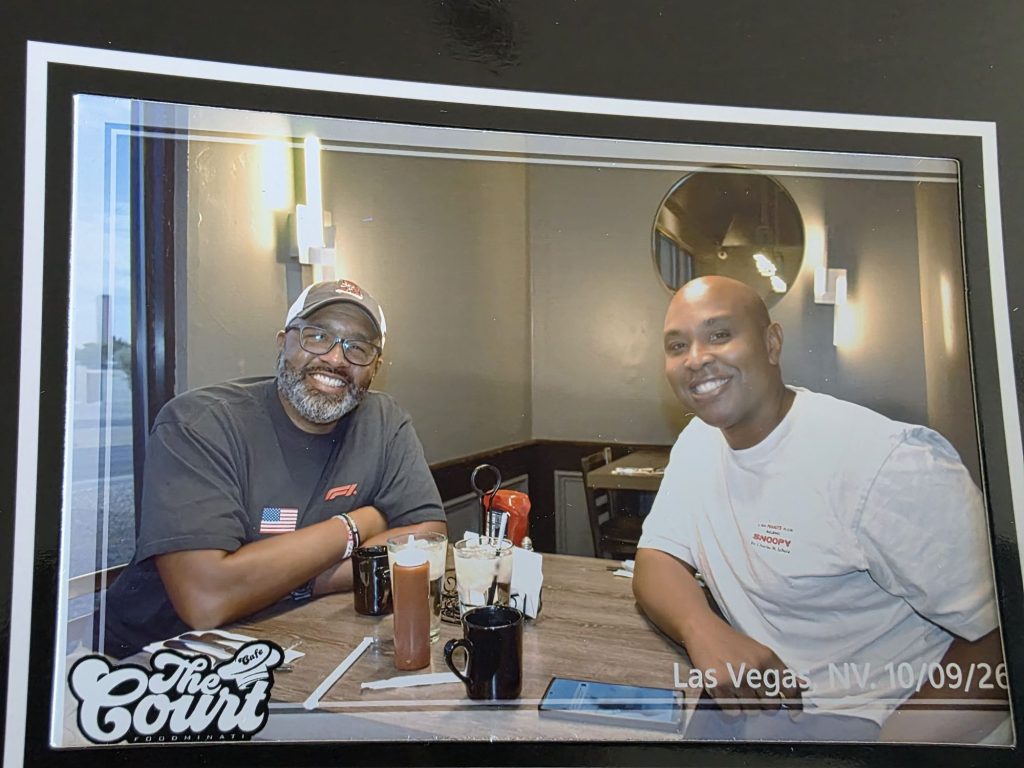
Fast-forward to October 2026. Greg was visiting Las Vegas for a guys’ trip, and we finally had the opportunity to meet in person.
We decided to get together for breakfast at Court Cafe Las Vegas, a Black-owned restaurant right here in the Las Vegas community.
Now, before I tell you about our reunion, let me give a little love to Court Cafe. First, the food was amazing! I’m talking about the kind of breakfast that makes you start thinking about when you’re coming back before you’ve even left the restaurant.
But what made that morning particularly special wasn’t just the food. It was the fellowship.
Here we were, two men who had been connected for nearly two decades, finally sitting across from each other, sharing a meal, laughing, reflecting, and catching up on life. And we were doing it at a Black-owned establishment.
For me, that added another meaningful layer to the experience. I’ve always believed in the importance of community, supporting local businesses, and recognizing the people and places that create opportunities for connection.
Sometimes building community looks like mentoring a young person. Sometimes it looks like checking on an old friend. And sometimes it looks like spending your money at a local business and telling other people about the experience.
So let me give a special shoutout to Court Cafe Las Vegas for the amazing food and for being part of a memory I’ll always cherish. If you’re in Las Vegas or planning a visit, check them out. Support this Black-owned business, bring somebody you care about, and enjoy some good food and conversation. I plan to return with the wife!
Now, back to Greg. Eighteen years. Think about that. Eighteen years of phone calls, emails, conversations, professional milestones, personal struggles, celebrations, and life transitions. And we had never once sat across from each other.
When we finally embraced, it felt like greeting someone I had known my entire life. Because, in many ways, I had. We didn’t need to spend time getting acquainted. We already knew each other.
The physical meeting was simply an opportunity to celebrate a relationship that had been built long before that morning. And as we sat there enjoying breakfast, I couldn’t help but appreciate how something as simple as reaching out for advice in 2008 had developed into a lifelong friendship.
So, How Do You Find a Mentor?
I keep coming back to that question on Threads. And I think sometimes we make mentorship more complicated than it needs to be.
We imagine a formal arrangement. Someone with an impressive title. Someone in our profession. Someone who lives nearby. Someone who agrees to meet with us regularly. And yes, mentorship can look like that. But it doesn’t have to.
Sometimes mentorship begins with an email. A conversation. A referral. A question. Or simply having the courage to reach out to someone you don’t know.
From a psychological perspective, meaningful relationships are built through trust, consistency, responsiveness, and the willingness to be vulnerable. Physical proximity can help relationships develop, but it isn’t the only way we establish meaningful connections.
And mentorship doesn’t always have to remain confined to the reason the relationship began. Sometimes the person who helps you navigate a professional challenge becomes someone who helps you navigate life.
The best mentors don’t just invest in what you’re trying to become. They care about who you are along the way.
That’s what Greg did for me.
Looking back, what makes our relationship so meaningful isn’t simply that Greg was a psychologist helping me become one. It’s that he never stopped seeing me as a person beyond my profession.
And I think that’s something we sometimes overlook about mentorship. The greatest impact isn’t always the professional advice someone gives us. Sometimes it’s knowing there’s someone in our corner when life gets difficult.
And here’s something else I’ve learned. Mentorship is not just about receiving. It’s also about taking what others have poured into you and making yourself available to someone else.
I think about the teachers, coaches, neighbors, community members, and even strangers who have contributed to my journey. Not all of them carried the title of mentor. But their influence mattered.
We often talk about the importance of having a village. Maybe we should spend more time recognizing the people who have been part of ours. And perhaps asking ourselves whether we’re becoming part of someone else’s.
One Final Thought
To the person who asked on Threads how to find mentorship: Start with a conversation. Be curious. Ask questions. Reach out. Understand that some people won’t respond, and that’s okay. But when someone does, don’t underestimate what that connection might become.
I reached out looking for guidance on getting into a doctoral program. Eighteen years later, I gained something far more valuable. A lifelong relationship.
And to Greg, if you’re reading this: Thank you for answering that initial call for help in 2008. Thank you for the encouragement, the prayers, the honest conversations, and the years of friendship.
And despite your questionable taste in college football, I’m grateful to call you my brother.
Mentorship isn’t always about being physically present. Sometimes it’s about consistently showing up.
Now, I’d Love to Hear From You
Before you go, I want you to think about a few things:
1. Who has been a mentor in your life? Was it someone who formally took you under their wing, or someone who simply showed up when you needed them?
2. Have you ever had someone believe in you before you fully believed in yourself? How did that change your journey?
3. Do you think mentorship requires face-to-face interaction? Or can meaningful relationships develop across cities, states, and even countries?
4. Here’s the big one: Who are you pouring into? Is there someone who could benefit from your experience, encouragement, or simply your willingness to listen?
I’d love to read your thoughts in the comments. And if someone came to mind while reading this, consider reaching out to them today.
Sometimes a simple ‘thank you’ can mean more than we realize. And sometimes one conversation can change the direction of someone’s life.
Maybe It’s Time We Talk About Mentorship
Writing this story has me thinking about something else.
How many of us have people in our lives who helped shape who we’ve become, yet we’ve never really taken the time to acknowledge them?
And how many of us are in a position today to offer someone else the same encouragement, guidance, or support we once needed?
I’m considering exploring these conversations through a mentorship series on The Daddy Durock Show.
Not just professional mentorship, but the people who have influenced our lives. Fathers, mothers, coaches, teachers, neighbors, community leaders, and sometimes complete strangers.
I want to hear those stories.
The people who believed in us. The ones who challenged us. The ones who stayed connected when life got complicated.
And perhaps most importantly, what we’re doing to pay that investment forward.
Because mentorship isn’t just about who helped us get here.
It’s also about who we’re helping along the way.
So here’s one more question:
If you could sit down with one person who helped shape your life, who would it be, and what would you say to them?
Maybe that’s a conversation worth having.
People. Purpose. Progress.
Listen to The Daddy Durock Show: Spotify | Apple Podcasts | Amazon Music


Leave a Reply